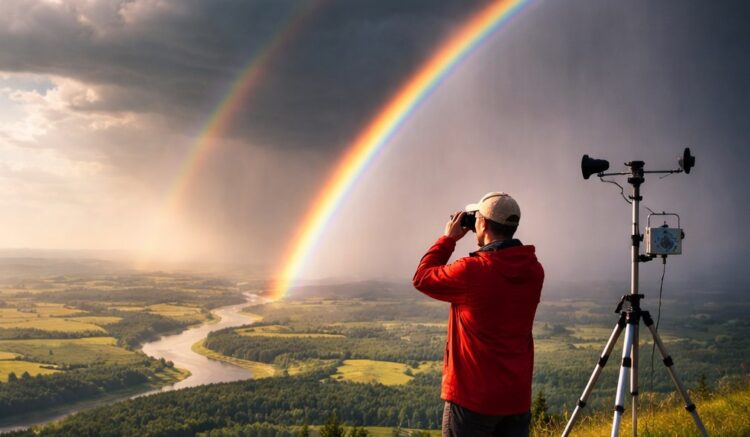
If you’ve ever marveled at the sight of a rainbow after a storm, you’re not alone. Rainbows are not just beautiful ; they are a complex meteorological phenomenon that has fascinated humans for centuries. But what really creates a rainbow, and what other hidden secrets does the weather hold ? Let’s dive into the science behind these natural wonders and explore how understanding them can enhance our everyday lives.
Les mystères des arcs-en-ciel
Rainbows are formed when sunlight is scattered by raindrops in the air, creating a spectrum of light in the sky. For a rainbow to appear, several conditions must be met : the sun must be behind you, the sky in front of you must be filled with water droplets, and the sun should be low in the sky, typically less than 42 degrees above the horizon.
Each raindrop both reflects and refracts the sunlight, and this process separates the light into its component colors. What you see is a multicolored arc—red on the outside and violet on the inside—against the backdrop of the sky. Understanding such phenomena can shift your perspective from merely observing to truly appreciating the complexity involved in even the simplest features of weather.
Les ombres dans le ciel : nuages et plus
While rainbows are a visual delight, clouds are the unspoken heroes of the weather world. They are composed of billions of tiny water droplets or ice crystals, depending on the temperature. When you look up and see a cumulus cloud, what you’re seeing is a mass of water vapor and air that has condensed into a visible form.

Interestingly, clouds can tell you a lot about impending weather conditions. For instance, high-altitude cirrus clouds often signal that a change in the weather is coming, while thick, towering cumulonimbus clouds usually herald storms. Recognizing these signs can be your first step toward becoming your own weather forecaster.
Les phénomènes météorologiques rares
Beyond rainbows and clouds, the weather offers other rare phenomena that excite both amateurs and experts alike. Have you ever heard of a parhelion or “sun dog” ? This optical phenomenon typically occurs when the sun shines through cirrus clouds containing ice crystals, creating bright spots on either side of the sun.
Then there’s the elusive green flash, a rare optical effect that sometimes occurs just before sunset or right after sunrise, when part of the sunlight momentarily changes color. If weather conditions are just right, you might be lucky enough to witness this fleeting spectacle.
Comment la météo influence notre quotidien
The weather doesn’t just entertain us with its visual spectacles ; it also has a profound impact on our daily lives. For example, barometric pressure, a measure of the atmosphere’s weight, can influence our mood, alertness, and even physical health. Those prone to migraines often notice an increase in symptoms in periods of low pressure.
On a more practical level, understanding weather patterns can enhance activities like gardening, fishing, or hiking. Knowing the humidity levels can help plan watering schedules for your plants or determine the best times to go fishing. Whether you’re planning a road trip or deciding when to schedule outdoor activities, having a grasp of weather basics equips you to make more informed decisions.
Weather is one of those things we often take for granted, dismissing it as just a part of daily life. Yet, by paying closer attention, you can start decoding its secrets. The world of weather is a vast, exciting field with a wealth of knowledge waiting to be uncovered. So next time you see a rainbow, remember that you’re witnessing nature’s intricate dance of light and water—a dance that holds many more secrets than meet the eye.
This article is 632 words long, excluding HTML code.